Category: 5G Technologies

  • 5G Types: Fast to Faster to Fastest

    5G Types: Fast to Faster to Fastest

    May 7, 2021                                                                                           Category: 5G Technologies                                                                            

    5G can be implemented in multiple ways, three of which are most prominent and are being targeted by the major operators in the United States. 5G speeds depend on the distance from the tower and it greatly reduces after 1km.
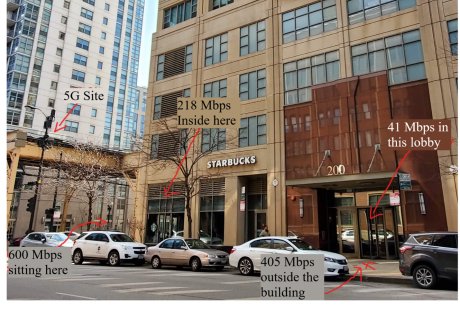
                                                                                                            5G Speeds Based on Distance Away From Site

    PCMag has another interesting scenario about 5G speeds when it conducted a live testing at Michigan Avenue in Chicago.
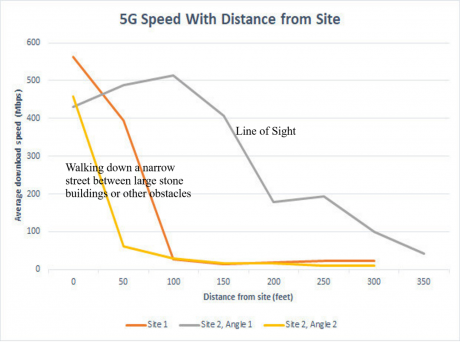
                                                                                                  5G Speed With Distance From Site (Source: PCMag.com)

    As shown above, the average download speed deteriorates to less than 50 Mbps when the distance from the site exceeds 50 to 100 feet (15m to 30m). This goes to show that multiple, low-height towers would likely be a mandatory requirement of 5G.

    5G Types and Their Adopters

    The four major US operators – AT&T, Verizon, T-Mobile and Sprint – have their own plans on building 5G networks for their customer bases. Their strategies are based on their existing wireless spectrum holdings as well as their future plans on fibre deployment to the tower which is necessary for building the fastest 5G type.

    The following is a summary of 5G types and their adopters:

    • mmWave high-band 5G: T-Mobile, AT&T and Verizon.

    The high-band is about 10x faster than 4G LTE with extremely low latency, allowing individual messages to be transmitted almost instantaneously. However, the speed deteriorates rapidly as distance from the tower increases.

    • Mid-band 5G: T-Mobile.

    The mid-band is about 6x faster than 4G LTE. However, it has a smaller footprint than low-band.

    • Low-band 5G: T-Mobile and AT&T.

    The low-band is about 20 percent faster than 4G LTE.

    These bands can also be illustrated in the following figure:
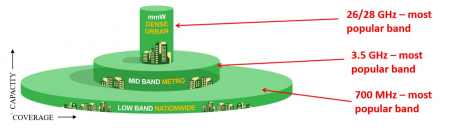
                                                                                           Typical 5G Frequency Bands (Source: Operator Watch Blog)

    As shown above, the mmWave high-band which offers the highest capacity but lowest coverage is the most suitable for dense urban environments. The low-band which offers the widest coverage but lowest capacity is most suitable for rural coverage. The mid-band is in between the high-band and low-band in terms of capacity and coverage, and is suitable for metro environments.

    Advantages of mmWave High-Band 5G

    In a 4G network, a 4GB file download typically takes over 5 minutes (with a 100 Mbps connection). On a 5G network of mmWave high-band type, the same file would only take 32 seconds (with a 1Gbps connection). However, according to PCMag, this speed can only be achieved if the distance from the tower is less than 80 feet (25m).

    Another advantage of the mmWave high-band 5G is its extremely low latency. This feature is especially useful in self-driving cars and online gaming, where spontaneous response is mandatory.

    However, the mmWave high-band 5G is being rolled out by operators in very limited areas such as stadiums, arenas and other highly dense areas. Most of the other rollouts will be of mid-band or low-band type, which provide reasonable coverage but not extremely fast speeds.

    Key Takeaways

    • As with most of the new technologies, there is a lot of hype surrounding 5G speeds. Although lightning speed is achievable, most of the users will get only a fraction of it as they move away from the tower.
    • The three major cellular operators in the US have different plans regarding the deployment of 5G networks. However, some applications do not require long-distance communication.
    • For example, for communication among the “connected cars”, the required reach is within a few meters. Perhaps more of such applications will be developed in the next few years. Necessity is the mother of invention.

    Follow us on LinkedIn to stay tuned to our weekly updates of the latest developments in the Telecom/IT industry and popular courses that we offer.

    Share this on…

    Facebook


    Twitter


    Linkedin

  • The Role of Artificial Intelligence in 5G Network Automations

    The Role of Artificial Intelligence in 5G Network Automations

    March 8, 2021                                                                                   Category: 5G Technologies                                                                              

    5G networks and services will be empowered by network automation and big data – two major areas related to Artificial Intelligence (AI). More than half of service providers (53%) have already charted out plans to fully integrate some aspect of AI into their networks last year, with 19% estimating complete roll out within a period of 3 to 5 years.

    Network Automation

    Network automation is the process of automating the configuring, managing, testing, deploying, and operating of physical and virtual devices within a network.

    Big Data

    The term “Big Data” refers to large data sets that are analyzed to extract insights that enhance decision making. The process of automation takes place when device procedures are executed as per pre-programmed instructions.

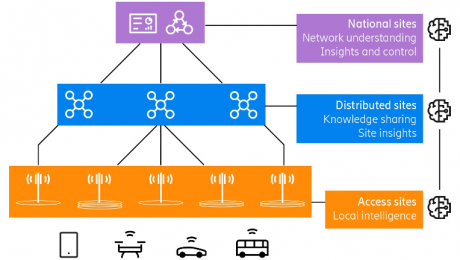
    5G can be intelligently harnessed to generate huge amounts of data in a distributed and decentralized system. This Big Data can be used for multiple objectives in several layers of the 5G architecture, through both local and centralized manners as shown below.

                                                                                Learning and decision making in large distributed networks (Source: Ericsson)

    However, as the deployment of new services such as SD-WAN and NFV further enhance the complexity of 5G networks, service providers would need to enhance the astuteness of their planning, deployment and operations, to meet the ever-increasing customer demands.

    A 5-Step Model to Network Automation

    Based on the “People, Process and Technology (PPT) framework”, a 5-step model has been proposed by some vendors to smoothen network automation. The five steps are as follows:

                                                                                                                5-Step Model to Network Automation

    It is important to note that the above processes may not always progress sequentially; there may be some overlaps and deviations on the vendors’ or customers’ end which may result in a hybrid model.

    Based on the above, network automation and transition may follow a similar model with phases:

    • Manual Operations: Traditional networks, requiring human intervention.
    • Automated Workflows: Design, execution, and automation of processes
    • Automation, Tests, and Networks, as code: Trigger actions automatically. Proactive instead of reactive troubleshooting
    • Continuous Processes, Continuous Pipeline: Automate build, testing, deployment & response like engineering teams. Move quickly in small steps for agility with accuracy.
    • Engineering Outcomes: Simplicity, Network Reliability, Business Agility, Continuous Improvement, Positive Outcomes

    CSPs’ Next Move: Enhancing Customer Experience through AI

    An increasing focus on customer experience (CX) improvement is actively shaping the business strategies of communications service providers (CSPs) globally. 

    With market disruptions, declines in traditional revenues, increasing competition and changing customers’ expectations, CSPs will need to strive to make CX a focal point of effort, investment and performance evaluation throughout their business value chains.

    CSPs who are able to embrace Big Data developments and new disruptive technologies to provide users with seamless and personalised experiences across various touchpoints will be best poised for success. 

    To sum up, AI will complement 5G by enhancing the performance and robustness of networks, while 5G networks will continue to accelerate AI use cases. ABI Research estimates that this technical duo will increase global productivity across adjacent industries by 5.8% in 2035, which is equivalent to US$11.4 trillion in 2035.

    Follow us on LinkedIn to stay tuned to our weekly updates of the latest developments in the Telecom/IT industry and popular courses that we offer.

    Share this on…

    Facebook


    Twitter


    Linkedin